Profiling (The Before)

Depending on your age, you might recognize this classic reference, or it might be new to you. In the golden age of comic books, there was always an ad featuring Charles Atlas, promising to transform you into a powerhouse of strength using his “Dynamic Tension” method.
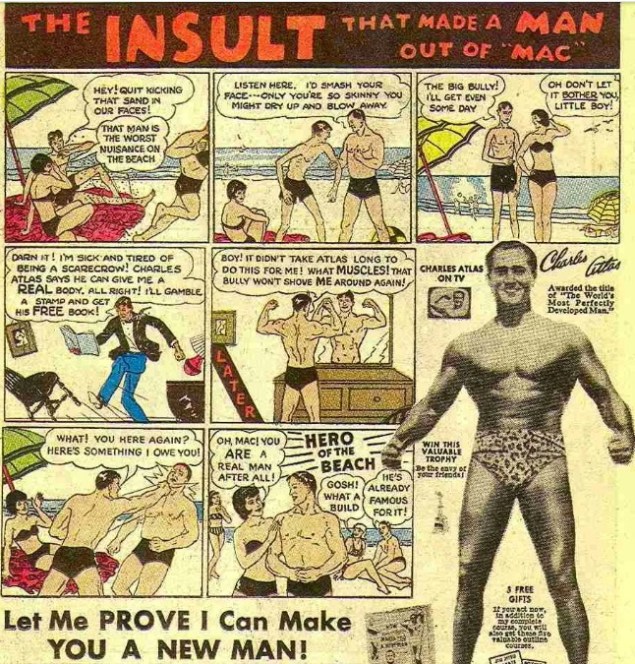
Now, whether or not you’ve seen that ad, the concept behind it is universally familiar: the journey from an undesired state to a better one, backed of course, by visible proof of progress. I like to call this
“The Before and After.”

The “Before”

This is where change begins, with a decision and a record. That record should reflect the kind of transformation you’re aiming for. Often, a simple photo will do the trick, but it can be anything else that captures your starting point and later, when you reach your “After”, becomes a reminder of how far you’ve come. 

The “After”

This is your destination, your goal. It can be short-term or long-term, but it must be realistic and achievable. So, please, let’s skip the fantasy of dropping 20 pounds in a month. Instead, commit to something sustainable and make it meaningful.

My Profile (Before)

Since this post is about Profiling (The Before), let me give you an idea, here’s my own starting profile. It includes both data and a photo, and I encourage you to do the same. Profiling will help you track progress and stay motivated.

And remember, your profile will differ in data depending on your goal, if what you want is to change your blood sugar levels, instead of a picture you would have a recent blood test as your “Before”. 

Now let’s see…

This is my beginning profile:

Name:  Miguel Andujar (Heta Akira)
Age:  61
Gender:  M
Height:  5′ 9″
Weight: 319 lbs
Fat %: 44.1
Waistline:  55″ 
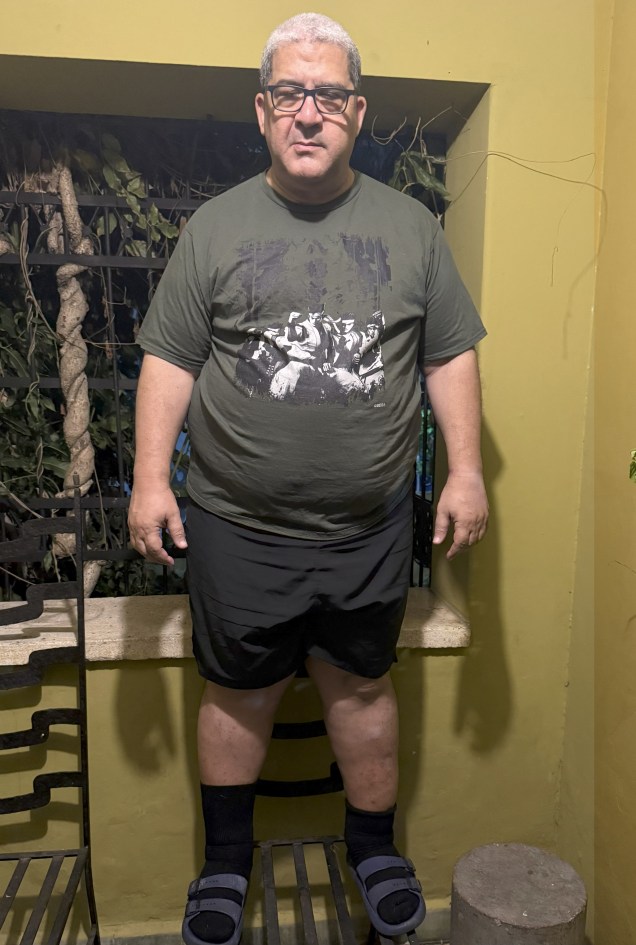

Note:  The T-Shirt is XL2!!!

Ok, now commit and go make your own “BEFORE”!  

No matter the plan, get your doctor’s “Blessing”

bpbeingtaken

Let us imagine that you already arranged a good plan for eating healthy and also will add a few hours of light exercise during the week.  Great!!!
A fair question would be:
Why, do I need to visit my doctor if he or she would 100% approve what I am planning to do?

The answer (totally in your favor) is: Because a medical checkup can get you essential information that you should consider during your weight loss program.

Let’s say that you go to the doctor and tests reveal that your blood sugar is too high. Of course, your doctor won’t tell you to drop your plan but maybe add medical suggestions that could improve how efective and safe it executes. Maybe you will get a note to keep away for certain foods or monitor your glucose levels. The same goes for blood pressure and other parameters that have a profound impact on your health.

A couple of years ago, I went to the doctor for a case of torticollis and some of the tests revealed a condition in the cervical area of my spinal cord (neck area) that requires attention. Luckily enough, the doctor said that “Cervical Therapy” would suffice. But my point is that because of this finding, the doctor strongly suggested keeping away from high impact exercises, even if I could go back to a normal weight.  This was not a preventive checkup, and I got very important for any fitness plan that includes exercise. So, knowing where you stand before initiating is always a wise decision.

Work with your doctor and try to get a health picture of you as wide as possible. The more information the better. I believe that your “Before” checkup should include but not limited to: 

1) Complete “Lipids Profile” (your Cholesterol numbers).  Please tell your doctor to include the not always present, genetic marker Apo (a) and the modernly used risk indicator Apo B.  
2)  Glucose Tests (your blood sugar numbers).  This is usually measuring your glucose level at the time of the test, but how about asking for an “A1C” test that is a better assessment for glucose healthy levels? and while you are at it, let us get a “Fasting Insulin” Test.  I am sure that your doctor won’t complain getting this additional knowledge. 
3) Liver Test is also mandatory when assessing metabolic health. If you are obese like me or even overweigh, there is the possibility of having some degree of NAFLD (Non-Alcoholic Fatty Liver Disease) aka Fat in your Liver. 

So go ahead! Get your doctor involved and start your journey knowing important things about your current self and that you have the approval of your medical professional for your journey to a healthier You!

When will the blog be UPDATED?

THBupdates

Starting next week, our Blog will be updated twice a week. There will be weeks that a third post could appear but that won’t be very often.

Of course, what better way to start than with “Monday” as the first day for posting. If there are sad news, I will leave them for the second post day, because on Monday, we need support, drive, and everything else that help us start our week with energy.

Thursday is the best candidate for the second post. This is aiming at an even split week: Monday+ 2Days + Thursday + 3Days.

Well, now that we know, mark your calendars and LET’S KEEP POSTING!

Body Fat with a Weight Scale

In the last post we decided that to monitor our progress we will concentrate on Fat.
And while we also said that BMI (Body Mass Index) could be a way to measure, I don’t think that BMI should be the method of choice nowadays.  BMI is good when you don’t have a smart scale around and you are not very muscular. 

If you want my opinion, I would skip BMI altogether and go right into BFP (Body Fat Percentage) as for us in this Blog, fat is the name of the game.

So, let us focus in getting a good Weight Scale (Smart Weight Scale). One that can compute Body Fat Percentage for us.

A Smart Weight Scale is not too different in appearance to any digital scale that only compute weight. Of course, after getting the results, the similarity ends. 

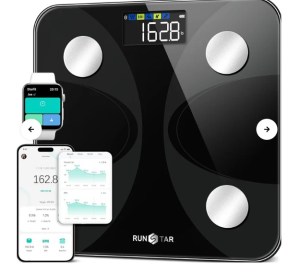
Here is a photo of the one that I am using now.  I believe it was like 25 dollars at Amazon. So is not like getting a proper device will break the bank for you. 

Now, in any modern digital weight scale, you will expect at least the following:
1) More than just Weight and BMI, again we won’t settle for less than a weight scale with Body Fat readings. Some scales can even split Fat in subcutaneous (under the skin) and the visceral fat (around the organs). In case you are wondering, having excess of visceral fat is worst. 
2) Phone (and sometimes smartwatch) App to track your data. You will pair your scale with your phone and every time you step into your scale, your data will be transferred automatically. 
3) Profiles is a desired feature if the weight scale is shared and there are other family members following your new healthy trend of tracking your weight and fat percentage. 

As I am not recommending any brand or model of weight scale, go online and see a couple of showdown videos to help your selection. Use a prompt like “Best Smart Scales of 2025” or something similar and start reviewing! 

Maybe some of you are asking yourself, what is the deal with this BFP?  I already got a good scale that measures weigh and BMI, why should I change to BFP?  After all most of doctors still rely on BMI on patients’ assessments. 

Yes, that is true. There are a lot of physicians that still use BMI for weight diagnostic, but this number is going down each year. Specially, after 2023 that the American Medical Association (AMA) redefined the limitations of BMI as a sole indicator for assessing weight and obesity risks. 

Ok, now to close this post, I will give you a practical example that will let you see why “BFP > BMI”.  

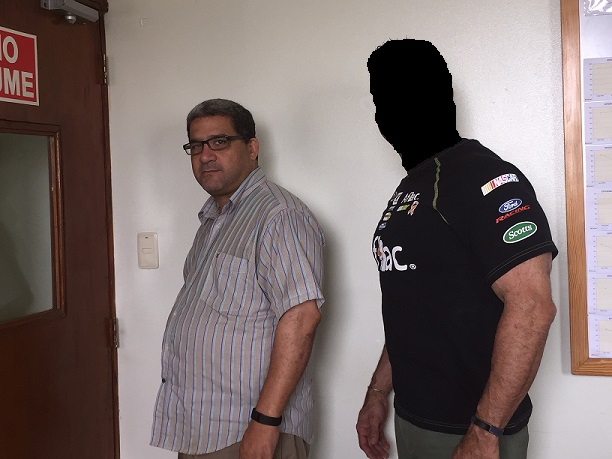
Here I got a photo (very old photo) that we will use to show our point. 
Look at the two subjects in the photo.

comparing

Although the one on the right is 4″ taller than me, consider the following data:

AGE:              53   –     52
WEIGHT:       274   – 229
HEIGHT:       5′ 9″   – 6′ 1″
BODY FAT:    49.6  –   19
WAISTLINE:  52”  –    34″
PANTS SIZE:  42  –    34″

BMI values =   40.5 – 30.2     to BMI, BOTH SUBJECTS ARE OBESE!!!


BUT if we go the BFP route, we see that in my case, half of my body is fat and in the subject of the right is less than 20% and that is why these two are so different at plain sight. 

Again, remember that the reason for this lack of precision on BMI is because it disregards entirely muscle mass. 

So let us get a good Smart Weight Scale that calculates BFP!

Just how fat are we?

If someone asks you this question: How Fat are you?  What would be your answer?
I am a few pounds overweight or slightly over my average weight or you dodge the question entirely and you answer with “I will start a diet next week”?

There is a problem giving sidestep replies like those above. They are all related to a value that is unknown and unclassified, except for the last one that is not even an answer. Now, here at THB (The Heta Blog) we will user something that works for everybody and I am not talking just about pounds. 

The thing is, when you see an overweight or obese person, what you are looking at is Fat or Excess Fat to be more specific. If you don’t understand, let me show you something

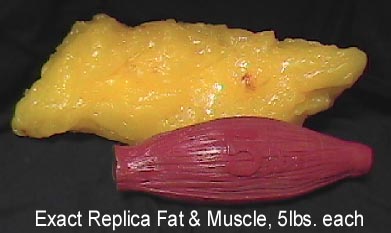
fat-v-muscle

Here you see five pounds of Fat and Muscle. Maybe by just looking at this picture you understand my point. Fat takes a lot more space than Muscle. That’s why sometimes you can see two men with the same weight but with distinct size of clothes.

Again, the important indicator for us to measure our fitness level is going to be BFP (Body Fat Percentage). In other words, how much of our body is fat.

Now the Big Question… How do we measure our BFP?

To measure BFP we have the following options:

1) DEXA Scan: A big machine that uses small emissions of X-ray to give us our body composition. This is the most accurate method but is also the most expensive. A session to determine your BFP would cost around $300.

2) Hydrostatic Weighing: In this method you are submerged into a water tank and the machine will measure your body fat. The logic behind this method is that being bone and muscle denser than water, a body with substantial amounts of body fat will be lighter. Hydrostatic Weighing is accurate and not so expensive as Dexa Scan but is not as available.

3) Skin Fold Caliper: This is a very popular method in gyms but since the device is not expensive you can get your own. Results are as accurate as your measuring skills. The idea is to pinch the skin at certain spots and measure with the tool. After that you will check the values with a conversion table that will give you the resulting BFP.

4) Bioelectric Impedance Analysis: This is the method used by many Weight Scales. Using a small electric current flow and measuring the electrical impedance (resistance) on the body you can get a relatively accurate value of your BFP.

 5) BMI (Body Mass Index): Well, this is not really a true method to measure BF, but in overweight and obese people it can sometimes be as accurate as the Bioelectric Impedance Analysis. The parameters needed for the formula are Height and Weight. Strangely enough, BMI is still the number one method for assessing body composition and there are scales that only have BMI.

Out of all five methods, we will be using 4 and 5.

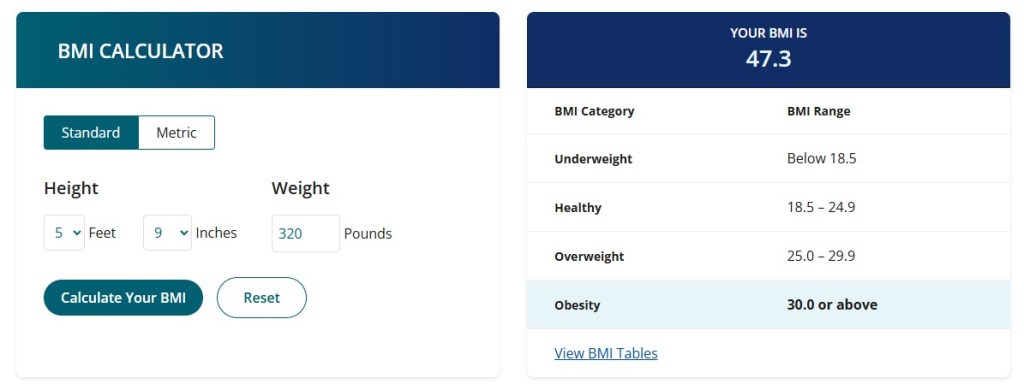
Now, to end today’s post, let’s get our BMI right now!
I know that my current weight is 320 pounds and that I am 5′ 9″.

For our test, we will use a BMI calculator from The US Department of Health & Human Services 

https://www.nhlbi.nih.gov/calculate-your-bmi

I went to the site, and using “Standard” System, I entered height and weight and clicked on “Calculate Your BMI”.

Well, there you have it folks! According to the resulting table, having a BMI above 30 will place you in the obese category. In my case, with a BMI of 47.3 that is way over plain obese. So just doing the effort to get out of this category will be a big task for me.

On our next post, we will learn how to use a Bioelectric Impedance Analysis Weight Scale and compare results.

See you in the next Post!    🙂

Who are we? Why are we here?

If you saw the “Readme First” section of this blog, then you already know that I am an obese person and that I will use this blog to document my trip into normal levels of weight and fat percentage.

As I already said in the RMF section, I am currently weighing over 300 pounds! that is a lot of weight above normal values.  The weight is an indicator of how much effort and time will be involved in this project.  In terms of procedure, it will be the same for three hundred pounds, four hundred pounds or two hundred pounds.  So don’t worry if you think that because of your current weight you are out of the scope of this trip. In fact, if you are an overweight person, instead of obese, you are PERFECT for this program because you are doing preventive action to avoid obesity and that puts you ahead of a lot of people.

I want you to know that obesity is not something that can be easily explained, believe me, I am an expert in the matter. So, if you find someone in the street that tells you: You just eat too many calories and exercise too little, please understand that he is giving you an over-simplistic explanation of your problem and that reduce knowledge about nutrition is more common that you might think. The reality is that without knowing it, you could be inside an extremely hard to break vicious cycle. We are talking about our body responding to behavior changes because of our biochemistry. This is not something that we can fix with a simple “Calories IN-OUT” approach. I wish it were that simple. But it’s NOT!

Let me finish this post by saying that change is possible and for that I have two amazing tools at my service.  Knowledge and Passion!  I know what to do and I have passion to follow up and get results.

So, get ready! Because the journey starts 9/15/2025!