If someone asks you this question: How Fat are you? What would be your answer?
I am a few pounds overweight or slightly over my average weight or you dodge the question entirely and you answer with “I will start a diet next week”?
There is a problem giving sidestep replies like those above. They are all related to a value that is unknown and unclassified, except for the last one that is not even an answer. Now, here at THB (The Heta Blog) we will user something that works for everybody and I am not talking just about pounds.
The thing is, when you see an overweight or obese person, what you are looking at is Fat or Excess Fat to be more specific. If you don’t understand, let me show you something
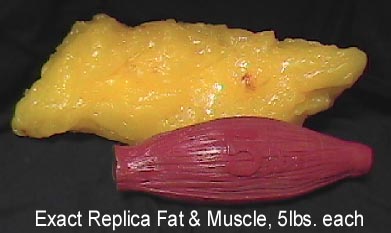
Here you see five pounds of Fat and Muscle. Maybe by just looking at this picture you understand my point. Fat takes a lot more space than Muscle. That’s why sometimes you can see two men with the same weight but with distinct size of clothes.
Again, the important indicator for us to measure our fitness level is going to be BFP (Body Fat Percentage). In other words, how much of our body is fat.
Now the Big Question… How do we measure our BFP?
To measure BFP we have the following options:
1) DEXA Scan: A big machine that uses small emissions of X-ray to give us our body composition. This is the most accurate method but is also the most expensive. A session to determine your BFP would cost around $300.
2) Hydrostatic Weighing: In this method you are submerged into a water tank and the machine will measure your body fat. The logic behind this method is that being bone and muscle denser than water, a body with substantial amounts of body fat will be lighter. Hydrostatic Weighing is accurate and not so expensive as Dexa Scan but is not as available.
3) Skin Fold Caliper: This is a very popular method in gyms but since the device is not expensive you can get your own. Results are as accurate as your measuring skills. The idea is to pinch the skin at certain spots and measure with the tool. After that you will check the values with a conversion table that will give you the resulting BFP.
4) Bioelectric Impedance Analysis: This is the method used by many Weight Scales. Using a small electric current flow and measuring the electrical impedance (resistance) on the body you can get a relatively accurate value of your BFP.
5) BMI (Body Mass Index): Well, this is not really a true method to measure BF, but in overweight and obese people it can sometimes be as accurate as the Bioelectric Impedance Analysis. The parameters needed for the formula are Height and Weight. Strangely enough, BMI is still the number one method for assessing body composition and there are scales that only have BMI.
Out of all five methods, we will be using 4 and 5.
Now, to end today’s post, let’s get our BMI right now!
I know that my current weight is 320 pounds and that I am 5′ 9″.
For our test, we will use a BMI calculator from The US Department of Health & Human Services
https://www.nhlbi.nih.gov/calculate-your-bmi
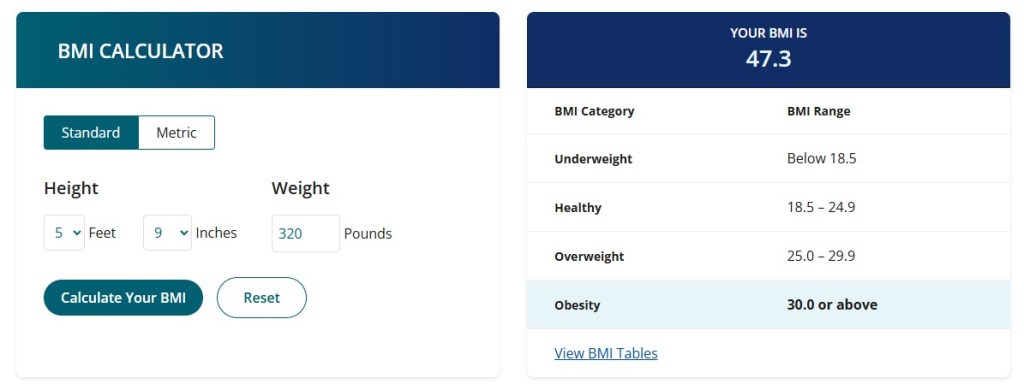
I went to the site, and using “Standard” System, I entered height and weight and clicked on “Calculate Your BMI”.
Well, there you have it folks! According to the resulting table, having a BMI above 30 will place you in the obese category. In my case, with a BMI of 47.3 that is way over plain obese. So just doing the effort to get out of this category will be a big task for me.
On our next post, we will learn how to use a Bioelectric Impedance Analysis Weight Scale and compare results.
See you in the next Post! 🙂
 THE HETA BLOG