In the last post we decided that to monitor our progress we will concentrate on Fat.
And while we also said that BMI (Body Mass Index) could be a way to measure, I don’t think that BMI should be the method of choice nowadays. BMI is good when you don’t have a smart scale around and you are not very muscular.
If you want my opinion, I would skip BMI altogether and go right into BFP (Body Fat Percentage) as for us in this Blog, fat is the name of the game.
So, let us focus in getting a good Weight Scale (Smart Weight Scale). One that can compute Body Fat Percentage for us.
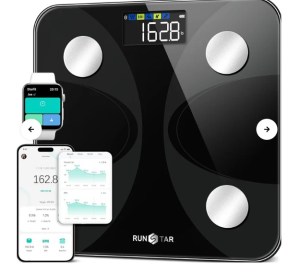
A Smart Weight Scale is not too different in appearance to any digital scale that only compute weight. Of course, after getting the results, the similarity ends.
Here is a photo of the one that I am using now. I believe it was like 25 dollars at Amazon. So is not like getting a proper device will break the bank for you.
Now, in any modern digital weight scale, you will expect at least the following:
1) More than just Weight and BMI, again we won’t settle for less than a weight scale with Body Fat readings. Some scales can even split Fat in subcutaneous (under the skin) and the visceral fat (around the organs). In case you are wondering, having excess of visceral fat is worst.
2) Phone (and sometimes smartwatch) App to track your data. You will pair your scale with your phone and every time you step into your scale, your data will be transferred automatically.
3) Profiles is a desired feature if the weight scale is shared and there are other family members following your new healthy trend of tracking your weight and fat percentage.
As I am not recommending any brand or model of weight scale, go online and see a couple of showdown videos to help your selection. Use a prompt like “Best Smart Scales of 2025” or something similar and start reviewing!
Maybe some of you are asking yourself, what is the deal with this BFP? I already got a good scale that measures weigh and BMI, why should I change to BFP? After all most of doctors still rely on BMI on patients’ assessments.
Yes, that is true. There are a lot of physicians that still use BMI for weight diagnostic, but this number is going down each year. Specially, after 2023 that the American Medical Association (AMA) redefined the limitations of BMI as a sole indicator for assessing weight and obesity risks.
Ok, now to close this post, I will give you a practical example that will let you see why “BFP > BMI”.
Here I got a photo (very old photo) that we will use to show our point.
Look at the two subjects in the photo.
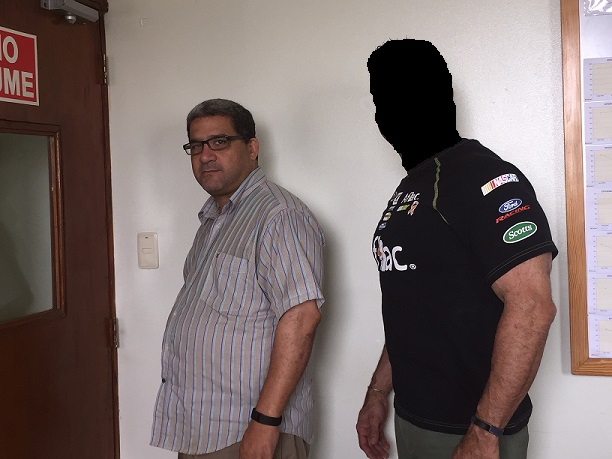
Although the one on the right is 4″ taller than me, consider the following data:
AGE: 53 – 52
WEIGHT: 274 – 229
HEIGHT: 5′ 9″ – 6′ 1″
BODY FAT: 49.6 – 19
WAISTLINE: 52” – 34″
PANTS SIZE: 42 – 34″
BMI values = 40.5 – 30.2 to BMI, BOTH SUBJECTS ARE OBESE!!!
BUT if we go the BFP route, we see that in my case, half of my body is fat and in the subject of the right is less than 20% and that is why these two are so different at plain sight.
Again, remember that the reason for this lack of precision on BMI is because it disregards entirely muscle mass.
So let us get a good Smart Weight Scale that calculates BFP!
 THE HETA BLOG